Pisanelli Bice PLLC, a Las Vegas-based litigation law firm, announced today that Joseph Antonuccio and Christopher P. Zimmerman have joined the firm as associates.
Mr. Antonuccio joins Pisanelli Bice after serving as Assistant Chief Counsel for the United States Department of Homeland Security in Washington, D.C. In that role, he represented the United States in court proceedings and handled matters at various stages of litigation through final disposition, including appellate work. He earned his Juris Doctor from The George Washington University Law School in 2023 and completed externships with U.S. Senator Catherine Cortez-Masto and Nevada Attorney General Aaron Ford while in law school. Mr. Antonuccio received his undergraduate degree from the University of Nevada, Reno, and is currently pursuing an LL.M. in Gaming Law and Regulation at the University of Nevada, Las Vegas. He is admitted to practice in Nevada and Washington, D.C., as well as before the U.S. District Court in Nevada.
Mr. Zimmerman joins the firm with experience in general liability and construction defect defense, having previously practiced at a large defense firm. A Las Vegas native, he earned his Bachelor of Science in Economics and Finance from the University of Nevada, Reno, where he also co-founded a technology company that secured six-figure angel investment. He received his Juris Doctor from Santa Clara University School of Law, earning a corporate specialization in high tech law, with honors. During law school, Mr. Zimmerman studied abroad at Singapore Management University, externed for the Honorable Evette Pennypacker of the Santa Clara Superior Court, and was an associate at the Entrepreneur’s Law Clinic. He is admitted to practice in Nevada and California, as well as before the U.S. District Court for the District of Nevada.
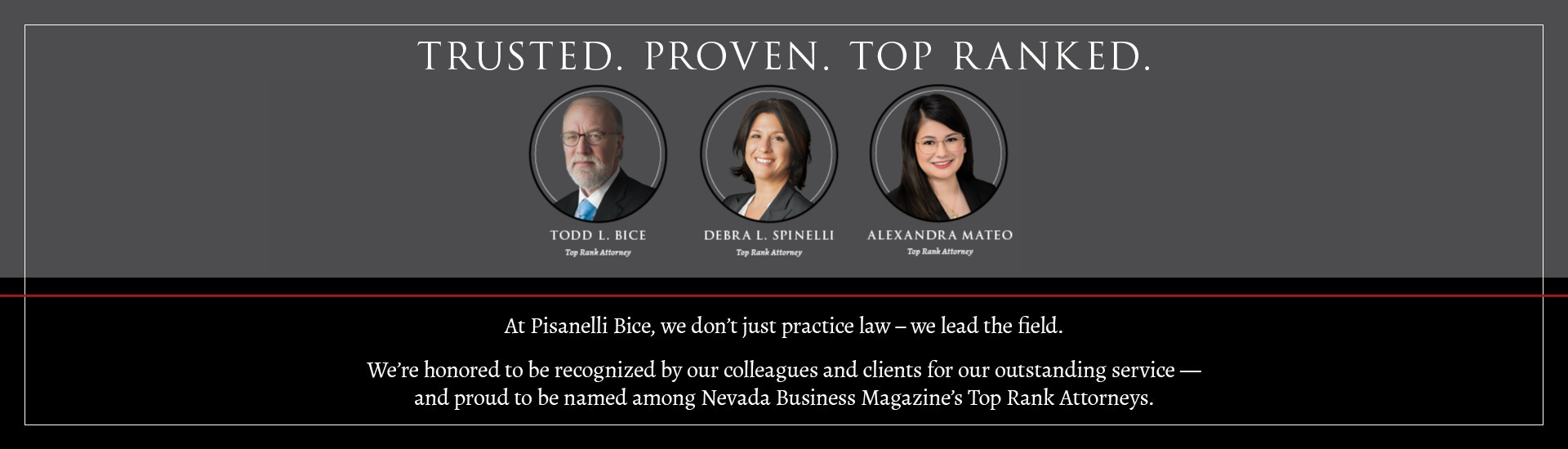
“Joseph and Christopher each bring valuable and distinct experience to our litigation team,” said Debra L. Spinelli, managing partner at Pisanelli Bice. “Their backgrounds in government, defense litigation, and business-focused legal work align well with our firm’s commitment to providing strategic and effective representation for our clients.”
Founded in Las Vegas, Pisanelli Bice represents individuals and businesses in complex litigation matters throughout Nevada and beyond.
Pisanelli Bice PLLC, a Las Vegas-based litigation firm, announced M. Magali Mercerahas been promoted to partner.
Mercera joined Pisanelli Bice in 2011 and has built a broad litigation practice focused on complex commercial disputes. She represents clients in matters involving breach of contract, fiduciary duty claims, real estate and construction disputes, and other high-stakes business litigation. Over the years, she has played a key role on trial teams handling some of the firm’s most significant cases.
“Magali has earned this promotion through years of excellent work, sound judgment and a deep commitment to our clients,” said Debra L. Spinelli, managing partner of Pisanelli Bice. “She is a trusted advocate and a valued leader within our firm, and we are so pleased to have her on our leadership team.”
In addition to her litigation practice, Mercera is actively involved in pro bono and community service efforts, including representing children in the foster care system through the Children’s Attorney Project. She is fluent in Spanish and regularly works with Spanish-speaking clients.
Pisanelli Bice is widely recognized for its trial practice and represents clients ranging from closely held businesses to large corporations, developers, gaming entities and governmental bodies. The firm is consistently ranked among Nevada’s leading litigation firms by national and regional legal publications.
Pisanelli Bice is a Las Vegas-based firm focused primarily on commercial litigation. The firm, founded by attorneys James J. Pisanelli and Todd L. Bice, represents clients ranging from single entity developers and entrepreneurs to Fortune 500 companies, municipalities, public agencies as well as some of Nevada’s largest gaming companies.
Read more here.
Pisanelli Bice PLLC, a Las Vegas-based litigation firm, announces the promotion of M. Magali Mercera to Partner.
Mercera joined Pisanelli Bice in 2011 and has built a broad litigation practice focused on complex commercial disputes. She represents clients in matters involving breach of contract, fiduciary duty claims, real estate and construction disputes, and other high-stakes business litigation. Over the years, she has played a key role on trial teams handling some of the firm’s most significant cases.
“Magali has earned this promotion through years of excellent work, sound judgment, and a deep commitment to our clients,” said Debra L. Spinelli, Managing Partner of Pisanelli Bice. “She is a trusted advocate and a valued leader within our firm, and we are so pleased to have her on our leadership team.”
In addition to her litigation practice, Mercera is actively involved in pro bono and community service efforts, including representing children in the foster care system through the Children’s Attorney Project. She is fluent in Spanish and regularly works with Spanish-speaking clients.
Click here to read more.
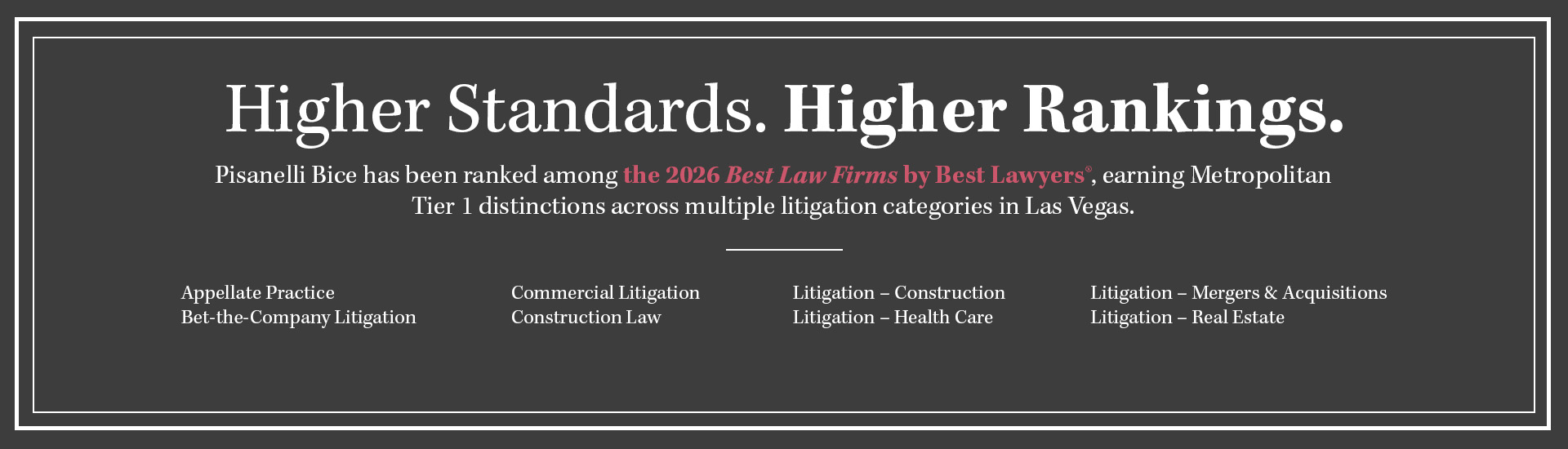
Pisanelli Bice PLLC, a premier litigation firm based in Las Vegas, has once again been recognized for legal excellence in the 2026 edition of Best Law Firms in America®, one of the legal industry’s most respected peer-reviewed accolades. The firm received eight Tier 1 honors in the highly competitive Las Vegas metropolitan category.
This recognition reflects the firm’s enduring commitment to legal excellence, professional integrity, and outstanding client service. Rankings in Best Law Firms are determined entirely by peer review and client feedback, underscoring the esteem in which Pisanelli Bice is held by both the legal community and those it serves.
The firm earned honors in the following practice areas:
· Metropolitan Tier 1 – Las Vegas:
o Appellate Practice
o Bet-the-Company Litigation
o Commercial Litigation
o Construction Law
o Litigation – Construction
o Litigation – Health Care
o Litigation – Mergers and Acquisitions
o Litigation – Real Estate
Click here to read more.
The legal industry continues to grapple with changing times. While managing client expectations is a challenge as old as the law itself, the next generation of legal professionals are creating new challenges by making work-life balance demands that have been unheard of in the industry. Artificial intelligence (AI) is also changing the legal game. Attorneys and clients hope to be able to commoditize AI to cut costs and address the overwhelming reputation of attorneys being unaffordable, but AI continues to be unreliable for much more than data organization.
Recently, a group of attorneys met at a roundtable sponsored by Nevada State Bank to discuss the challenges the legal industry faces. Connie Brennan, publisher and CEO of Nevada Business Magazine, served as moderator for the event. These monthly roundtables bring together different industries to discuss issues and solutions.
Gregory Gilbert: They reason why the AI issue is so intriguing and earth shattering is because it impacts the entire court system. It impacts how we think and practice as people. It impacts the way young lawyers think about the practice of law. And it impacts the way that clients think about how quickly an answer should be provided to them. There are ethical issues and competence issues with AI. To attorneys, it is an absolute game changer.
Alicia Ashcraft: Twice in the last four to six months, I have had clients who drafted contracts using AI and sent them to me for review to economize and stretch dollars. Since lawyers are expensive, the thought process is, if a client can use ChatGPT to create their own contract and only have the attorney review it, it will be cheaper. But they include huge sections of information that require review. They were able to draft a contract in 15 or 20 minutes, but they wonder why they were billed two hours for it.
James Pisanelli: Everyone at this table has been practicing long enough to know the transition of technology making things better. Email, for instance, has become the plague of commercial litigation because it has made everything so expensive. And, though technology was developed that made the analysis of email better, it did not necessarily make it cheaper for the client because that technology also comes at great expense. We can go back even further with research. Most of us grew up in an actual library when we were associates. Then Westlaw came along, and LexisNexis. But they did not make it necessarily cheaper for the client because they came with their own expense as well. The open question is, as AI finds its place in what we do, who will it benefit? Will it benefit the owners and the controllers of the AI programming? Will it benefit the lawyers? Probably yes, across the board. Will it benefit the actual clients? I am not so sure.
Dana Dwiggins: It is going to shift the focus, in large part, from what the attorneys are charging to what these companies that control the AI are charging. We had a situation recently that flabbergasted me. We always ask clients how they were referred to us and twice we have received referrals from ChatGPT. The question is, when will it start monetizing referrals so that attorneys can advertise on it?
Ashcraft: I have a friend who is a transcriptionist and she is being given programs and transcripts that were initially transcribed through AI and then she was told to clean it up. Every time she makes a correction, she is teaching the program. In essence, she is teaching the program to put her out of business. That is pretty much what we are doing every time we log in to Westlaw or LexisNexis AI and generate a document and then correct it. AI is going to hit the lower technical folks first and then work its way up.
Mark Ricciardi: The legal research and brief writing is only one piece of the AI tool. We are going to see enormous strides in efficiency when it comes to document review, document production, drafting and transcript review. We have been telling people that AI is not going to put them out of a job, it is going to make them more efficient. It will allow them to get more done, and our clients will reap some benefits from that.
Avece Higbee: AI could easily expose the laziness qualities that some of the newer attorneys have. It could come to the point where they are the ones that are not going to practice law anymore.
Gilbert: AI will severely impact the number of lawyers that are necessary and the type of lawyers that are necessary. And probably in one year, this conversation will be completely different than the one we are having right now.
Samuel Schwartz: AI is dangerous in some ways, but in other ways it is going to commoditize a lot of what we do and make it a little more affordable.
Barbara Buckley: AI still cannot be trusted on its own. We had a trial where we found out that the expert witness used AI, and the [citations] were wrong. We had the expert report stricken. It is still not reliable at all, and attorneys are getting into trouble because of it.
Dwiggins: There was a Judge Hardy decision up north that came out recently where he was reviewing the brief, the opposition wrote an approximate 20-page opinion of the 20 cases and four of them were made up. Sixteen of them did not even have the quoted items that were in the cases. The attorney ended up getting fired from the firm. He got sanctioned and referred to the state bar.
Michael Feder: AI can be much more of an asset than a liability so long as it is used correctly. You still have to put the information in to get it out. The fear whenever we do a document review is that we are going to miss a key document. I am not 100 percent comfortable with it yet, but I am getting there.
Schwartz: You have to ask the right questions when you try to use AI. Even when you do that, it still is not always right. It is getting better every day, but it is there to organize, not to replace.
John Steffen: The problem that we all face constantly is the difficulty in finding competent, hardworking and loyal attorneys, paralegals and staff to keep up with the ever-increasing workload that we all have.
Ricciardi: It is a challenge to find competent and good lawyers, especially at a level where they are able to handle cases and it is probably going to continue to be a challenge in the future.
Dwiggins: There was, in recent years, a plateau of attorneys because the number of attorneys passing the bar was similar to the number retiring. That has been part of the problem in finding new talent.
Pisanelli: From a firm management perspective, there is just no question, the primary challenge we face is the recruiting issue, in particular with trying to be in a space that is typically occupied by large firms. We are competing with salaries for the best talent.
Charles Gianelloni: Another challenge that we are spending a lot of time dealing with is trying to keep associates engaged and happy in this post-COVID world. With previous generations, you could pay a certain amount of money, and they would just work. Now that does not seem to necessarily be what associates want. Matching what associates want and need with what the firm needs is a big challenge.
Higbee: The quality of the legal profession, with some of the younger attorneys, is also a little scary. Many of them are bright and really want to work, and some of them plan on working just a little while in law before they open their own CrossFit.
Pisanelli: All of us will agree on the frustration of the new generation bringing a new culture into our firms that is different than what we learned. We were working more hours and were thinking about our problems and our clients’ problems, virtually 24/7. They are not. Culturally, they are willing to only give you so much of their life, and that is the end of it. That is frustrating from the firm management perspective. But we would probably all agree if we were talking about that same associate and they happen to be one of our kids, then from that perspective we would probably think good for them. Because I have been down that path and know what it is like. I know how it ages you in dog years.
Feder: I applaud those who think of work-life balance coming out of law school because I do not think any of us thought about that. We already knew that 2,000 or 3,000 hours a year were coming. I remember my wife telling me to go and do what needed to be done while we still did not have kids. She told me that she would see me in a couple of years. In today’s world, when it is five o’clock, the new attorneys are going home.
Pisanelli: There is something about it that I admire. I do not love it in the middle of a trial and when I am not getting what I need immediately, but I do admire it. Culturally, this new generation is coming in and saying these are the rules of the game. If we do not like it, then there are seven other law firms down the street that will probably pay them more.
Feder: There is a balance there. Those who are willing to put those long hours in stand out now in our offices more so. That used to be the norm. Now it is unusual.
Dwiggins: It is also hard to find associates that want to work in the office. They do not fully understand that you learn by interaction, and you cannot learn on your own at home.
Feder: Many of our younger attorneys want more of a hybrid approach between the office and home. We need to get back to that one-on-one interaction so that they can learn.
Gilbert: Our industry is still structured on the apprentice model. You learn so much by being in the trenches and being in the wars and learning from your own mistakes. Being around people, sharing ideas and having an actual sense of fear and obligation to the client with performance anxiety motivates us to talk to each other. It motivates us to pick up the phone and call colleagues to ask them if they have experience in a certain area. If you are in your den doing your own thing, you are not exposed to that.
Gianelloni: One thing that has been successful in bridging that gap since we do not have those water-cooler moments anymore, is our partners forcing check-ins with our people at home. Every Monday and Wednesday, they have required Zoom check-ins or calls, or they can be at the office. That little push has helped some of our associates developmentally to improve, which is good for everybody.
Click here to read more